
If you're running a growing business, you've probably hit that point where your phone system needs an upgrade. Maybe you're still using those old copper-line phones, or perhaps you're considering making the jump to VoIP. Either way, you're facing a decision that could impact your bottom line and how your team communicates for years to come.
Let's break down the real differences between traditional phone systems and VoIP, so you can make the right choice for your business.
What We're Actually Comparing Here
Traditional phone systems (also called POTS – Plain Old Telephone Service) are the copper-wire systems that have been around forever. They use analog signals to carry your voice and typically require a bunch of hardware sitting in your office, like PBX equipment.
VoIP (Voice over Internet Protocol) takes your voice, turns it into digital data, and sends it over your internet connection. No copper wires, less hardware, and way more flexibility.

The Case for Traditional Phone Systems
Don't write off traditional systems just yet. They've got some real advantages that might matter for your business.
What Traditional Systems Do Well
The biggest selling point? Rock-solid reliability. When your internet goes down, your traditional phone system keeps working. No buffering, no dropped calls due to bandwidth issues, just consistent service.
These systems have been perfected over decades. They deliver clear call quality and work the same way every single time. For businesses where every call matters (think emergency services or customer support), that reliability is worth its weight in gold.
The Downsides Are Pretty Significant Though
Here's where traditional systems start to hurt your wallet. The upfront costs are brutal – you're looking at $500 to $2,000 per user just for the hardware. Then add installation, wiring, and setup costs on top of that.
Scaling up is a nightmare. Want to add five new employees? You'll need new hardware, more wiring, and probably a technician visit. It's expensive and time-consuming.
The features are also pretty basic. You get voicemail, caller ID, call waiting, and three-way calling. That's about it. No video calls, no mobile integration, no advanced analytics – just the bare bones.
Plus, your employees are tied to their desks. Want to work from home? Good luck routing calls properly.
Why VoIP Is Winning Over Growing Businesses
Here's where things get interesting. VoIP has basically solved most of the problems that made traditional systems attractive, while adding features that growing businesses actually need.

The VoIP Advantages
Cost savings are huge. Since you're using your existing internet connection and minimal hardware, your startup costs are way lower. Most VoIP providers charge predictable monthly fees, and long-distance calls are often free or dirt cheap.
Scaling is stupidly easy. Need to add ten new users? Just log into your admin panel and add them. Takes about five minutes. No new hardware, no technician visits, no rewiring your office.
The feature set is where VoIP really shines. We're talking video conferencing, call recording, analytics, CRM integration, mobile apps, auto-attendants, and unified communications. Your phone system becomes a complete business communication hub.
Flexibility is unmatched. Your team can take calls on their desk phone, laptop, tablet, or smartphone. Working from home? No problem. Traveling? Your business number follows you everywhere.
The Potential Drawbacks
VoIP's biggest weakness is its dependence on your internet connection. If your internet is spotty or slow, your call quality suffers. And if your internet goes down completely, so does your phone system (unless you have backup solutions in place).
That said, most businesses today have reliable internet, and VoIP providers offer redundancy options to minimize downtime.
Head-to-Head Comparison
| Feature | Traditional Phone System | VoIP System |
|---|---|---|
| Startup Costs | $500-$2,000+ per user (hardware, installation, wiring) | Under $100 per user (minimal hardware) |
| Monthly Costs | Higher service fees, expensive long-distance rates | Lower service fees, cheap/free long-distance |
| Adding New Users | Requires hardware purchase and installation | Add users online in minutes |
| Features | Basic calling, voicemail, caller ID | Video conferencing, analytics, CRM integration, mobile apps |
| Work Location | Tied to office desk | Call from anywhere on any device |
| Reliability | Independent of internet, very stable | Depends on internet quality |
| Call Quality | Consistently good | HD quality with good internet |
| Maintenance | Requires on-site tech support, expensive parts | Provider manages remotely |
| Integration | Limited, requires separate systems | Integrates with business software |
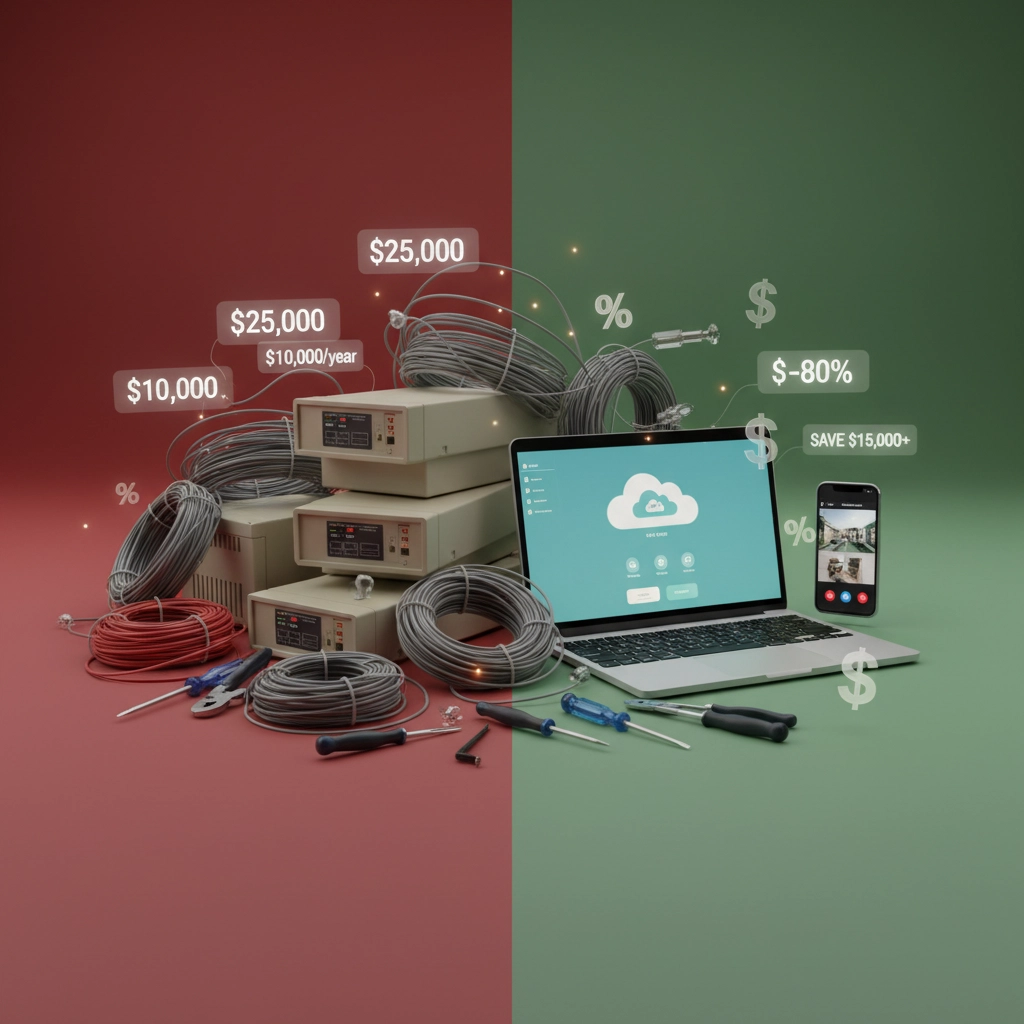
So Which Should You Choose?
For most growing businesses, VoIP is the clear winner. The cost savings alone make it attractive, but the real value comes from the features and flexibility that help your business operate more efficiently.
Go with VoIP if:
- You have reliable internet (and most businesses do these days)
- You want to minimize upfront costs and get predictable monthly expenses
- Your team needs flexibility to work from different locations
- You want advanced features like video conferencing and CRM integration
- You're planning to scale and don't want phone system logistics holding you back
- You prefer having your provider handle maintenance remotely
Stick with traditional systems if:
- Your internet connection is unreliable or frequently goes down
- Your business operations absolutely cannot tolerate any communication disruptions
- You're in a very remote area with limited internet options
- Your current traditional system is working fine and replacement costs are a major concern
The Reality Check
Here's the thing – the reliability gap between VoIP and traditional systems has narrowed significantly. Modern VoIP systems, when properly set up with redundancy and backup options, are nearly as reliable as traditional systems.
Meanwhile, the feature gap has only gotten wider. Traditional systems are basically stuck in the 1990s while VoIP keeps adding capabilities that growing businesses need.
For most companies, the question isn't really whether VoIP is reliable enough – it's whether you can afford to miss out on the cost savings, features, and flexibility that VoIP provides.

Making the Switch
If you decide VoIP is right for your business, the transition is usually smoother than you'd expect. Most VoIP providers offer migration support, and you can often port your existing phone numbers over.
The key is choosing a provider that understands business needs and offers the reliability features that give you peace of mind. Look for redundancy options, quality customer support, and uptime guarantees.
At the end of the day, your phone system should help your business grow, not hold it back. For most growing companies, that means VoIP is the way to go.
Ready to explore VoIP options for your business? Check out what Voipone can offer at voipone.online – we specialize in simple, reliable VoIP solutions that grow with your business.